
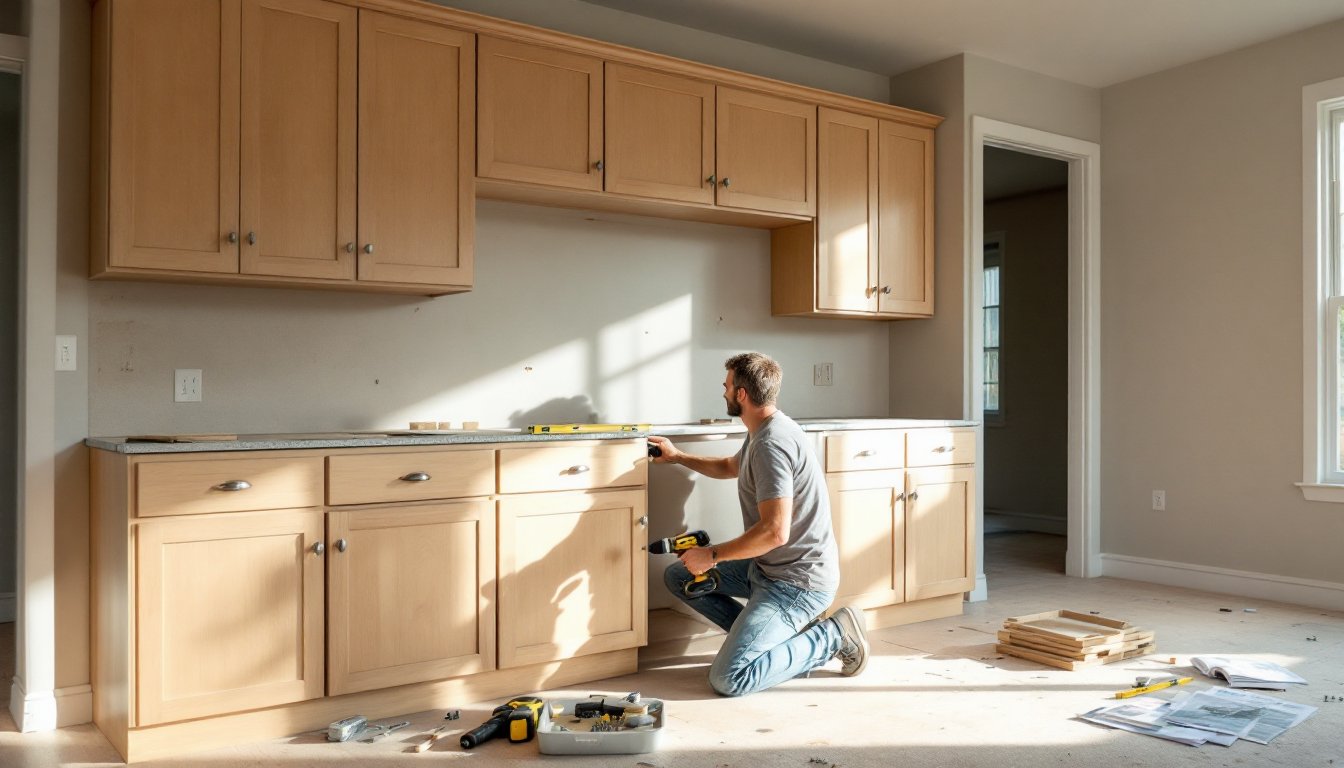
Menards has been a go-to source for DIYers and budget-conscious homeowners tackling kitchen renovations for decades. Their cabinet selection combines reasonable pricing with a range of styles that work for both quick flips and full remodels. Whether someone’s planning a complete teardown or just swapping out dated boxes, understanding what Menards offers, and what trade-offs come with the price point, makes the difference between a smooth project and a frustrating one. This guide walks through the cabinet lines, real-world pricing, quality expectations, and installation considerations to help homeowners decide if Menards fits their project.
Table of Contents
ToggleKey Takeaways
- Menards kitchen cabinets offer a practical middle ground between budget big-box retailers and premium custom options, with frequent rebates that can save hundreds on a full order.
- The Cardell® line provides the best value for most DIY projects with plywood construction, dovetail drawers, and full-extension glides at $2,500–$3,500 for a standard 10×10 kitchen.
- Box construction quality is the most critical durability factor—plywood boxes (Cardell® and Kitchen Classics®) significantly outperform particleboard and resist moisture damage and warping better.
- Accurate measurements across multiple wall heights and careful attention to out-of-plumb surfaces are essential to avoid installation failures, as walls rarely run perfectly parallel.
- DIY installation is feasible for competent homeowners but requires 2–4 days, proper tools, and careful stud placement, while professional installation costs $75–$150 per linear foot.
- Menards kitchen cabinets can deliver 10–20+ years of reliable performance depending on the line chosen, making them a smart investment for homeowners who match the product tier to their project timeline.
Why Choose Menards for Your Kitchen Cabinets?
Menards positions itself in the accessible middle ground: better selection than big-box competitors like Lowe’s or Home Depot in many regions, but without the sticker shock of specialty cabinet retailers. The stores stock ready-to-assemble (RTA) and semi-custom options, making them practical for DIYers who want to handle installation themselves.
One major advantage is in-store availability. Unlike ordering from online-only RTA suppliers, homeowners can inspect door styles, finishes, and construction quality before committing. Menards also runs frequent rebate promotions (their notorious 11% mail-in rebate), which can shave hundreds off a full kitchen order if someone’s patient with the paperwork.
The trade-off? Selection varies by location. Larger Menards stores carry more extensive displays and stock, while smaller locations may require special orders with lead times of 2-4 weeks. Customer service quality is hit-or-miss: some stores have knowledgeable design staff, others don’t. For homeowners comfortable doing their own layout and measurements, that’s less of an issue.
Menards Kitchen Cabinet Lines and Styles
Menards offers several distinct cabinet lines, each targeting different budgets and aesthetic preferences. Understanding the differences helps match the right product to a project’s scope and longevity expectations.
Value Choice™ is the entry-level line, basic particleboard construction with thermofoil or melamine finishes. These are fully assembled, which saves time but limits customization. Expect simple Shaker-style and flat-panel doors. They work for rental properties, basement kitchens, or temporary solutions, but won’t hold up to decades of daily use. Hinges are often basic Euro-style: soft-close upgrades aren’t standard.
Cardell® cabinets sit in the mid-range. They feature plywood box construction (a significant durability upgrade), dovetail drawer boxes, and full-extension undermount glides. Door styles include raised panel, recessed panel, and more refined Shaker profiles. Finishes range from painted whites and grays to stained oak, maple, and cherry. Cardell cabinets come as RTA, so plan on assembly time, but the quality-to-price ratio is solid for a primary residence kitchen.
Kitchen Classics® represents Menards’ semi-custom tier. These offer the most finish and door style options, including glazed, distressed, and two-tone combinations. Box construction is plywood, and hardware options include soft-close hinges and drawer glides as standard. Lead times can stretch to 4-6 weeks for custom configurations, so early ordering is critical if working on a timeline.
Most lines are frameless (Euro-style) construction, which maximizes interior space but requires precise installation. Wall cabinets typically come in 30″, 36″, and 42″ heights, with base cabinets at the standard 34½” height (36″ with countertop). Filler strips and trim pieces are sold separately, don’t forget to account for those in the budget.
Pricing and Budget Considerations
Menards cabinet pricing for a standard 10′ × 10′ kitchen layout (a common industry benchmark) typically ranges from $1,200 to $4,500 depending on the line and finish selected. That’s for cabinets alone, no countertops, hardware, or installation labor.
Value Choice™ runs roughly $1,200–$1,800 for a 10×10 layout. These are the most budget-friendly but sacrifice longevity and refinement. Cardell® cabinets land in the $2,500–$3,500 range for the same footprint, offering better construction and finish quality. Kitchen Classics® semi-custom options start around $3,500 and can push past $5,000 with premium finishes and accessories.
Those figures assume standard configurations. Specialty units like lazy Susans, pull-out trash bins, spice racks, and appliance garages add $75–$300 each. Crown molding, under-cabinet lighting, and decorative end panels also drive costs up. Many homeowners find cost estimators on sites like HomeAdvisor helpful for ballparking total project expenses, including countertops and installation.
Rebate timing matters. Menards’ 11% rebate comes as store credit, not cash, and takes 6-8 weeks to process. Factor that into the budget if counting on the rebate to offset other materials. Also, watch for seasonal promotions (Memorial Day, Labor Day, Black Friday), cabinet discounts of 15-20% aren’t uncommon.
Shipping and handling fees apply to large orders, typically $100–$200 depending on the store’s delivery area. Some locations offer free delivery over a certain threshold: ask before finalizing the order.
Quality and Durability: What to Expect
Menards cabinets won’t rival custom cabinetry from a local shop, but they hold up well for their price point, if expectations are realistic. The key is matching the product tier to the project’s intended lifespan.
Box construction is the most critical quality indicator. Particleboard boxes (Value Choice™) are prone to moisture damage and sagging over time, especially around sinks and dishwashers. If going this route, use a quality underlayment under the sink and seal all edges thoroughly. Plywood boxes (Cardell® and Kitchen Classics®) resist moisture better and handle weight from heavy dishes or canned goods without warping. Standard plywood thickness is ½” for sides and ⅝” for the bottom, adequate for residential use.
Drawer boxes in the mid-tier lines use dovetail or dowel joinery with ½” solid wood sides. These are strong enough for daily use and won’t pull apart like stapled or glued joints. Full-extension glides with 75-100 lb. weight ratings are standard on Cardell® and up. Cheaper lines use ¾-extension glides, which make accessing items in the back a hassle.
Door and drawer fronts vary by finish. Thermofoil (a vinyl wrap over MDF) is easy to clean but will peel or bubble if exposed to heat or high humidity near stoves or dishwashers. Painted MDF doors are more durable but can chip at edges with heavy use. Solid wood doors (maple, oak, cherry) with stained finishes offer the best longevity and can be refinished if scratched, though they’re pricier and may expand or contract slightly with seasonal humidity changes.
Hinges and hardware on entry-level cabinets are functional but basic. Upgrading to soft-close hinges (around $3–$5 per hinge) drastically improves the feel and reduces wear on door frames. European-style hinges are adjustable in three dimensions, which is critical for getting doors aligned perfectly during installation.
Expect 5-10 years of solid performance from Value Choice™ in low-use scenarios, 10-15 years from Cardell® in a primary kitchen, and 15-20+ years from Kitchen Classics® with proper care. For context, custom cabinets often last 25-30 years or more.
Installation Options: DIY vs. Professional
Installing Menards cabinets is within reach for a competent DIYer, but it’s not a solo afternoon project. Plan on 2-4 days for a typical kitchen, depending on the layout complexity and whether walls are plumb and level (spoiler: they rarely are).
RTA cabinets (Cardell® and some Kitchen Classics®) require assembly first. Each box takes 20-40 minutes with a cordless drill, wood glue, and clamps. Instructions are straightforward, but production assembly-line speed isn’t realistic, budget extra time. Pre-assembled cabinets (Value Choice™) skip this step but are bulkier to maneuver.
Essential tools for installation include a 4′ level, stud finder, cordless drill with various bits, cabinet screws (#8 × 2½” for wall studs, #8 × 1¼” for joining boxes), shims, and a pry bar for adjusting alignment. A laser level makes marking cabinet heights across multiple walls far easier, though a traditional level and chalk line work. A jigsaw or oscillating multi-tool is necessary for cutting access holes for plumbing and electrical.
Wall cabinets go up first. Locate and mark studs, cabinets must anchor into at least two studs per unit, typically spaced 16″ or 24″ on center. Use a ledger board (a temporary 1×3 or 1×4 screwed level at the cabinet bottom height) to support cabinets during installation. Standard upper cabinet height is 54″ from the floor (18″ above a 36″ countertop), but adjust based on ceiling height and homeowner preference. Fasten through the cabinet back rail into studs with 3″ cabinet screws, drywall anchors won’t cut it for long-term support.
Base cabinets follow. Start in a corner and work outward, shimming as needed to level. Uneven floors are the norm: shims at the base and along the back even things out. Join adjacent cabinets together with cabinet screws or bolts through the side panels before securing to the wall. Use a clamp to pull cabinet faces flush before drilling. Install toe kick boards last, after countertops are on.
Permits and codes: Cabinet installation typically doesn’t require a permit, but any electrical or plumbing work does in most jurisdictions. If relocating outlets, adding undercabinet lighting, or moving a sink drain, consult local building codes and consider hiring licensed trades for those portions. The National Electrical Code (NEC) requires GFCI protection for kitchen outlets, and the International Residential Code (IRC) has specific requirements for kitchen ventilation and clearances around cooking surfaces.
Professional installation through Menards or contractor services found on ImproveNet typically costs $75–$150 per linear foot installed, including removal of old cabinets. For a 20-linear-foot kitchen, that’s $1,500–$3,000 in labor. If walls are in poor shape, the layout is complex (lots of corners, angled walls), or the project includes crown molding and intricate trim, professional installation can save headaches and ensure a polished result.
How to Measure and Plan Your Cabinet Layout
Accurate measurements are non-negotiable. Most cabinet installation failures trace back to measurement errors or failing to account for out-of-square walls and uneven floors.
Start by drawing a scaled floor plan of the kitchen. Graph paper works, but free tools like RoomSketcher or even Menards’ online kitchen planner simplify the process. Mark the locations of windows, doors, electrical outlets, switches, plumbing lines, gas lines, and HVAC vents. Note the swing direction of doors, a cabinet placed too close to a doorway creates a traffic jam.
Measure wall lengths at multiple heights. Walls built decades ago rarely run perfectly parallel. Measure at floor level, counter height (36″), and upper cabinet height (54″). Use the smallest dimension for cabinet planning to avoid gaps or forced fits.
Check for plumb and level. Hold a 4′ level vertically against walls to see if they lean. Hold it horizontally to check if floors slope. Note out-of-plumb conditions over ¼”, these require shimming during installation. Floors that slope more than ½” over 10 feet may need leveling compound before base cabinets go in, or the countertop installer will have a tough time.
Account for appliances. Standard appliance widths: 30″ or 36″ for ranges, 30″ or 33″ for refrigerators, 24″ for dishwashers. Check the manufacturer’s specifications for the exact models being installed, some higher-end appliances require extra clearance for doors or handles. Leave 1″–2″ of wiggle room for each appliance opening: it’s easier to fill a small gap with a filler strip than to widen an opening after cabinets are installed.
Plan for filler strips wherever cabinets meet walls or appliances. 3″ filler strips are standard: they allow for scribing to uneven walls and ensure doors and drawers open fully without hitting adjacent surfaces. Menards sells fillers in matching finishes, order them with the cabinets.
Upper and lower cabinet alignment matters for a clean look. Line up the edges of uppers with the edges of base cabinets or appliances below whenever possible. If the range is 30″ wide, center a 30″ range hood or cabinet above it. Symmetry reads as intentional: misalignment reads as mistake.
Countertop overhang is typically 1″–1½” beyond the cabinet face. If planning a breakfast bar or island seating, standard overhang is 12″–15″ to allow knee space, and this requires corbels or support brackets every 24″ to prevent sagging. The IRC requires supports for overhangs exceeding 6″ with certain countertop materials.
Double-check everything before ordering. A cabinet delivered in the wrong size or finish adds weeks to the timeline and often can’t be returned once assembled.
Conclusion
Menards cabinets deliver solid value for homeowners who prioritize affordability and hands-on involvement. The Cardell® line hits the sweet spot for most DIY kitchen remodels, good construction, reasonable pricing, and enough style options to avoid the builder-grade look. Take the time to measure carefully, understand the limitations of each product tier, and don’t skip prep work during installation. A well-planned Menards kitchen can look sharp and function reliably for years without the custom cabinet price tag.