
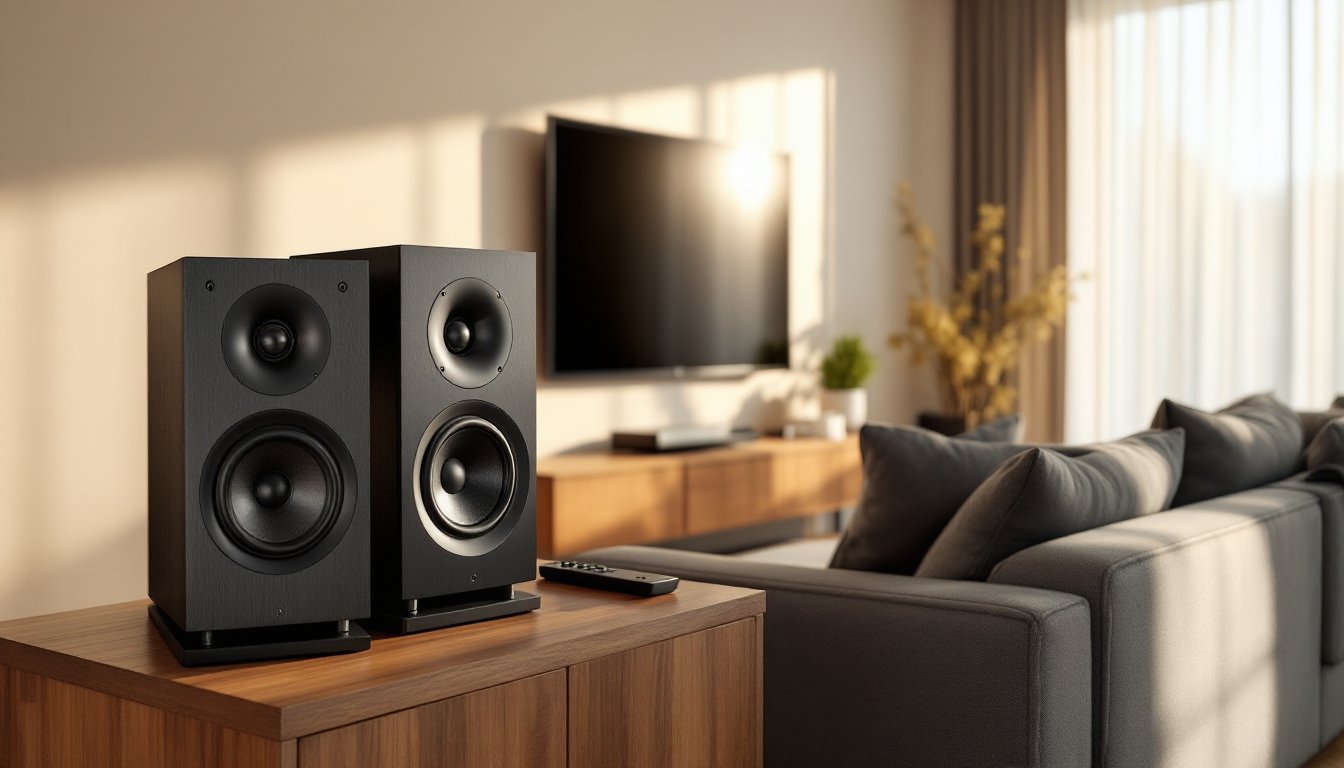
Walk into most dedicated home theaters and you’ll see massive tower speakers flanking a projector screen. But for the rest of us, working with real living rooms, actual furniture, and partners who veto cable spaghetti, bookshelf speakers deliver theater-grade sound without dominating the room. They’re compact, adaptable, and when paired with a solid receiver and subwoofer, they’ll rattle your walls during an action sequence just fine. Whether you’re upgrading from a soundbar or building a surround system from scratch, choosing the right bookshelf speakers means balancing size, sensitivity, impedance, and whether you’re willing to spring for separate amplification. This guide walks through what matters, what doesn’t, and which models earn their shelf space in 2026.
Table of Contents
ToggleKey Takeaways
- Bookshelf speakers deliver theater-grade sound without dominating your room, making them ideal for living spaces where floor space and aesthetics matter.
- When selecting bookshelf speakers for home theater, prioritize sensitivity ratings above 87 dB and match impedance to your receiver’s specifications to avoid distortion.
- Budget-friendly options like the Polk Audio Monitor XT20 and Sony SSCS5 provide legitimate home theater performance under $300/pair, while premium models like the KEF Q350 offer superior imaging and cabinet construction for audiophiles.
- Proper placement and setup—including toe-in angle, tweeter height at ear level, and correct wall clearance based on port design—matter more than chasing spec sheets.
- Integrate your bookshelf speakers with a subwoofer by setting them to ‘Small’ in your receiver’s menu, routing bass below 80 Hz to create a cohesive surround system that scales with your budget.
Why Bookshelf Speakers Are Perfect for Home Theater Setups
Bookshelf speakers punch above their weight class. Unlike tower speakers that need floor space and careful placement to avoid bass bloat, bookshelf models fit on existing furniture, wall-mounted brackets, or dedicated stands. That flexibility matters when you’re working around a sectional couch or can’t drill into a rental’s walls.
They’re also the backbone of versatile surround systems. A typical 5.1 setup uses bookshelf speakers as fronts and surrounds, letting a dedicated subwoofer handle the low-end grunt work below 80 Hz. This division of labor means you’re not paying for massive woofers in every speaker, just clean mids and highs where dialogue and effects live.
Most bookshelf speakers use a two-way design: a tweeter for highs and a mid-woofer (usually 4–6.5 inches) for everything else. This keeps the crossover simple and the sound coherent. Three-way designs exist but add cost and complexity without much benefit in a room under 300 square feet.
The real win? Scalability. Start with a stereo pair for music and casual viewing, then add a center channel and surrounds as budget allows. Tower speakers lock you into a specific aesthetic and layout from day one.
What to Look for When Choosing Bookshelf Speakers
Sensitivity rating (measured in dB) tells you how loud a speaker gets with one watt of power at one meter. Anything above 87 dB pairs well with modest AV receivers in the 50–75 watt-per-channel range. Below that, you’ll need more power or a separate amplifier to hit reference levels without distortion.
Impedance matters more than most retailers admit. Most bookshelf speakers run at 8 ohms, which any receiver handles easily. Drop to 4 ohms and you’re drawing more current, fine for beefy amps, risky for budget receivers that’ll clip or overheat. Check your receiver’s spec sheet before committing.
Frequency response lists the range a speaker covers, typically 50 Hz–20 kHz for bookshelf models. The lower number matters most: anything below 60 Hz means less reliance on a subwoofer for action movies. But don’t chase spec sheets blindly, real-world performance depends on room acoustics and placement.
Cabinet construction separates good speakers from shelf clutter. MDF (medium-density fiberboard) at ¾-inch thickness is standard: it’s dense enough to kill cabinet resonance without the cost of hardwood. Avoid hollow plastic enclosures, they’ll rattle during bass-heavy scenes. Look for internal bracing and a rear port (or sealed design) that suits your placement options. Rear-ported speakers need 6–12 inches of clearance from walls to breathe: sealed designs sacrifice a bit of low-end extension but work tucked into tighter spaces.
Many experts, including those featured in comprehensive speaker reviews, emphasize the importance of auditioning speakers in person when possible, as measurements only tell part of the story.
Top Bookshelf Speakers for Home Theater in 2026
Budget-Friendly Options Under $300
Polk Audio Monitor XT20 (around $200/pair) delivers surprising clarity for the price. The 6.5-inch woofer digs down to 48 Hz, reducing subwoofer dependency for smaller rooms. Sensitivity sits at 90 dB, so even a 50-watt receiver pushes them to satisfying volumes. The rear port demands wall clearance, but the included rubber feet work on most surfaces. Dialogue stays crisp even during layered soundtracks, a common weakness in this price tier.
Sony SSCS5 (typically $150/pair) shows up in every budget roundup for good reason. The three-way design adds a dedicated midrange driver, smoothing out vocal frequencies that two-way designs sometimes muddy. At 87 dB sensitivity, they’re efficient enough for entry-level receivers. The build quality feels budget-appropriate, thin vinyl wrap over MDF, but the sound outperforms the aesthetics. These work well as surrounds in a 5.1 setup, letting you allocate more budget to front speakers.
Jamo S 803 (around $200/pair on sale) brings Danish minimalism to the crowded budget space. The compact footprint (13 inches tall) fits shelves that reject bulkier models, and the front-firing port tolerates near-wall placement. Sensitivity hits 88 dB, and the 5-inch woofer crosses over to a soft-dome tweeter at a well-tuned frequency. These shine in smaller rooms (under 200 square feet) where placement flexibility trumps raw output.
Testing by audio publications featured in detailed bookshelf speaker comparisons confirms these models offer legitimate home theater performance without requiring high-end amplification.
Premium Picks for Audiophiles
KEF Q350 (around $700/pair) uses the brand’s signature Uni-Q driver array, a tweeter mounted in the center of the woofer. This coaxial design creates a point-source that images like a much larger speaker. Frequency response extends to 42 Hz, and the 6.5-inch woofer handles everything from whispered dialogue to explosion transients without compression. At 87 dB sensitivity, they pair well with quality receivers in the 75–100 watt range. The cabinet uses internal bracing you can’t see but absolutely hear, zero cabinet resonance even at reference levels.
ELAC Debut Reference DBR62 (roughly $700/pair) prioritizes neutrality over flash. The custom-designed woofer and tweeter deliver ruler-flat frequency response from 44 Hz up, meaning what the director mixed is what you’ll hear. Sensitivity sits at 86 dB, so budget for a capable amp. The rear port is large enough to breathe easily with just 4–6 inches of wall clearance. These disappear sonically, the mark of accurate speakers, letting the soundtrack take center stage without coloration.
Wharfedale Diamond 12.2 (around $600/pair) brings British voicing to home theater. The midrange warmth flatters older action movies and streaming content with aggressive compression. Sensitivity checks in at 88 dB, and the 6.5-inch Kevlar woofer reaches down to 45 Hz. The curved cabinet edges reduce diffraction, widening the sweet spot, useful when half the couch misses the center axis. Build quality exceeds the price point: real wood veneer, magnetically attached grilles, and binding posts that accept banana plugs or bare wire.
Several models featured in professional speaker testing consistently rank these premium options for their imaging precision and dynamic range in challenging home theater scenes.
How to Position and Set Up Your Bookshelf Speakers
Angle matters. Point the tweeters toward the primary seating position, this is called toe-in. Start with 10–15 degrees of angle and adjust by ear. Too much toe-in and the soundstage collapses: too little and dialogue drifts off-axis. Use a protractor app on your phone or eyeball it with painter’s tape on the floor as a reference line.
Height should place tweeters at ear level when seated. That’s typically 36–42 inches off the floor. If your bookshelf sits lower, tilt the speakers upward using adhesive wedges or DIY shims cut from scrap wood at a 5–10 degree angle. Wall-mounting works, but invest in brackets with tilt/swivel adjustments, the $15 no-name mounts lock you into one position forever.
Distance from walls depends on port design. Rear-ported speakers need 6–12 inches of clearance to avoid boomy bass. Front-ported or sealed designs tolerate tighter spaces, but even they benefit from a few inches of breathing room. If you’re stuck with a shallow shelf, stuff the port with foam (acoustic port plugs run $10–15) to convert rear-ported speakers into quasi-sealed designs. You’ll lose a bit of low-end extension but gain placement flexibility.
Speaker wire should be 16-gauge for runs under 50 feet, 14-gauge beyond that. Polarity matters: connect positive to positive, negative to negative, or you’ll get phase cancellation that kills bass response. Strip ½ inch of insulation, twist the strands tight, and use the binding posts or spring clips on both the speaker and receiver. Banana plugs make disconnecting easier but aren’t required.
Run your receiver’s auto-calibration (Audyssey, YPAO, Dirac, etc.) after placement. Set the microphone at head height in the main seating position and let it measure. The system will set crossover points, distances, and levels. Then tweak by ear, auto-cal tends to over-tame treble. Most rooms benefit from a +1 to +2 dB boost around 8–12 kHz to bring back air and detail.
Subwoofer integration closes the loop. Set bookshelf speakers to Small in your receiver’s menu, which routes bass below 80 Hz to the sub. Place the sub near a corner for maximum output, or use the “subwoofer crawl” method: put the sub in your seat, play bass-heavy content, and crawl around the room’s edges until you find the spot with the smoothest response. Swap the sub and your seat positions, that’s your ideal placement.
Conclusion
Bookshelf speakers solve the real-world problem of delivering cinema sound without requiring a dedicated theater room or a forklift. The budget options above will embarrass most soundbars, and the premium picks rival towers costing twice as much. Focus on matching sensitivity to your receiver’s power output, account for port placement in your space, and don’t skip the setup phase, proper positioning and calibration matter more than chasing spec sheet bragging rights. Start with a solid stereo pair, add a subwoofer when budget allows, and expand to surround channels as your space and wallet permit. The gear matters, but how you use it matters more.