
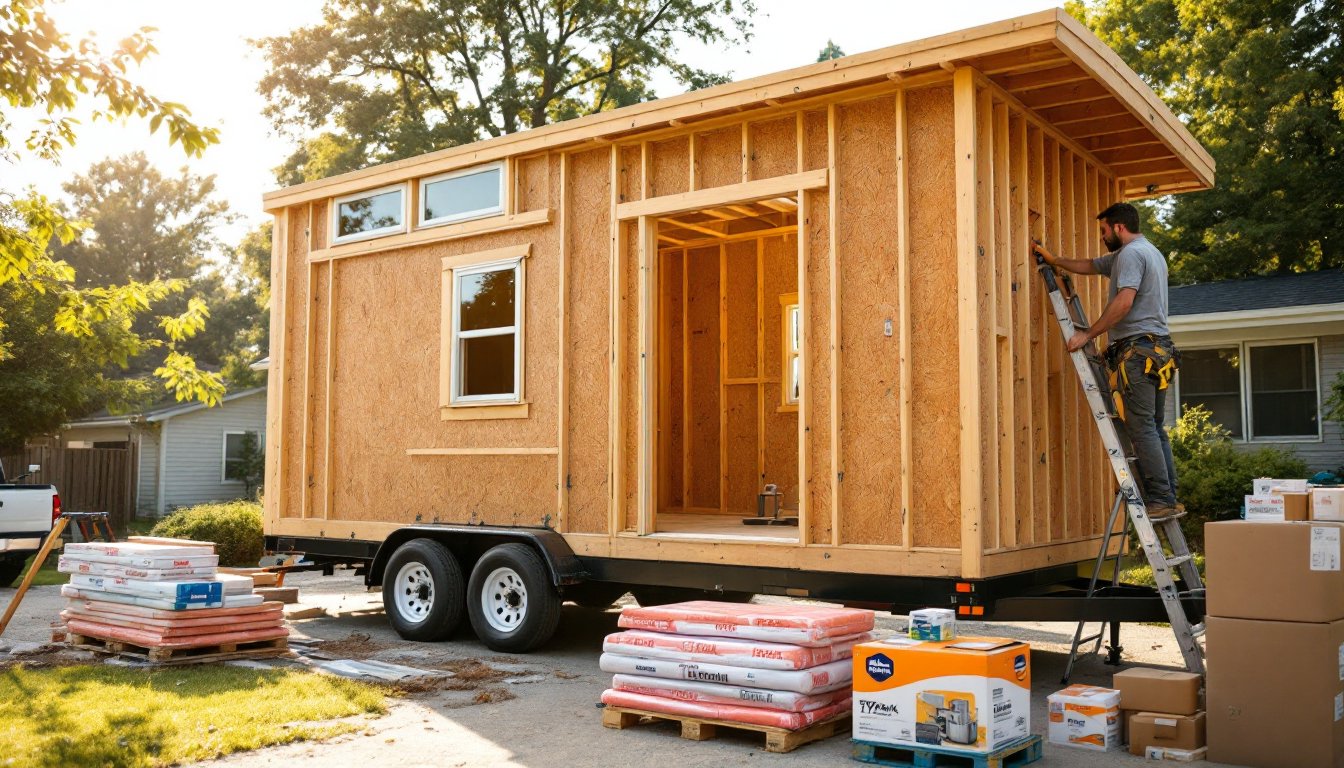
Lowe’s doesn’t sell turnkey tiny homes on their showroom floor, but they stock nearly everything needed to build one from the ground up. Whether someone’s framing a THOW (tiny house on wheels), converting a shed, or building a backyard ADU, Lowe’s carries the framing lumber, insulation, windows, fixtures, and finishes required for small-scale construction. The challenge isn’t availability, it’s knowing what to buy, how much to budget, and how to shop strategically for a build where every square foot and every dollar counts. This guide breaks down exactly what’s available, what it costs, and how to make the most of a Lowe’s tiny house material run.
Table of Contents
ToggleKey Takeaways
- Lowe’s stocks nearly 90% of essential materials needed for a tiny house build, including framing lumber, insulation, fixtures, and space-saving components like barn door hardware and compact appliances, making it a comprehensive one-stop supplier for DIY builders.
- A typical 200-square-foot tiny house build from Lowe’s costs between $7,200–$11,800 in materials, with framing and structure accounting for $3,150–$4,950 and fixtures adding $1,500–$2,700 to the overall budget.
- Smart shopping strategies like ordering online for guaranteed availability, purchasing lumber in bulk for contractor pricing, and shopping clearance items for fixtures can significantly reduce costs on a Lowe’s tiny house project.
- Space-saving fixtures such as 24–30 inch vanities, pocket doors, barn door hardware, and compact appliances are critical for maximizing functionality in tiny homes and are readily available at Lowe’s.
- Proper insulation selection—including fiberglass batts, rigid foam board, and closed-cell spray foam for tight spaces—is essential for tiny house energy efficiency and moisture control, with Lowe’s offering both DIY kits and materials for professional installation.
- Always inspect framing materials before purchase and use exact measurements to avoid overbuying, since tiny house construction tolerances are tighter than conventional builds and waste must be minimized.
What You Can Actually Buy at Lowe’s for a Tiny House Project
Lowe’s doesn’t carry prefab tiny homes or complete kits labeled “tiny home Lowe’s,” but their building materials section is essentially a tiny house supply depot. Builders can source dimensional lumber (2x4s, 2x6s, 4×4 posts), plywood sheathing, house wrap, and metal roofing, all standard items for any framing project, tiny or otherwise.
What Lowe’s does carry that’s particularly useful for compact builds: space-saving fixtures, barn doors, pocket door hardware, compact appliances, and modular storage systems. Their selection of LP SmartSide and James Hardie fiber cement siding works well for exterior cladding on tiny homes, offering durability without excessive weight, critical for THOW builds where trailer weight limits matter.
Lowe’s also stocks trailer anchoring hardware, hurricane ties, and structural fasteners that meet code for wind and seismic loads. While they won’t have a specialty tiny house trailer in stock, they do carry tie-down straps, lag bolts, and steel brackets suitable for anchoring a structure to a foundation or trailer frame. For anyone wondering about Lowe’s tiny homes for sale as complete units, that’s not the business model. But as a one-stop supplier for raw materials? They cover about 90% of what a typical tiny house build requires.
Essential Building Materials Available at Lowe’s
Framing, Insulation, and Structural Supplies
Framing a tiny house follows the same principles as conventional stick-framing, just on a smaller footprint. Lowe’s stocks kiln-dried SPF (spruce-pine-fir) studs in 2×4 and 2×6 dimensions, remember that a 2×4 actually measures 1.5″ x 3.5″. For a tiny house with 8-foot walls, plan on 92-5/8″ precut studs spaced 16″ on center for load-bearing walls, or 24″ O.C. for non-bearing partitions if local code allows.
Engineered lumber like LVL (laminated veneer lumber) beams and rim board is available for headers over windows and doors. For a loft sleeping area, common in many tiny house layouts, use 2×6 or 2×8 joists rated for residential floor loads (typically 40 PSF live load). Lowe’s can provide span tables, but for anything over 8 feet, double-check the IRC (International Residential Code) or consult a structural engineer.
Insulation options include fiberglass batts (R-13 for 2×4 walls, R-19 or R-21 for 2×6), rigid foam board (polyiso or XPS), and spray foam kits for irregular cavities. Tiny houses benefit from closed-cell spray foam in tight spaces like wheel wells or around windows, where thermal bridging is a concern. Lowe’s carries DIY spray foam kits (e.g., Great Stuff Pro) for small areas, but a professional spray foam contractor is worth it for whole-wall applications.
For sheathing, 7/16″ or 1/2″ OSB is standard and budget-friendly, though CDX plywood offers better moisture resistance if the build will sit exposed during construction. Don’t skip the house wrap (Tyvek or similar), it’s the primary air and moisture barrier. Many modern prefab and modular designs use advanced envelope systems, but for a DIY tiny build, proper house wrap installation is non-negotiable.
Interior Finishes and Space-Saving Fixtures
Interior finishes in a tiny house need to do double duty: look good and save space. Lowe’s stocks 1/2″ and 5/8″ drywall, plus lightweight options like 1/4″ plywood paneling or tongue-and-groove pine for a cabin aesthetic. Drywall is heavier but provides fire resistance (important for code compliance and insurance). For ceilings under lofts, consider 1/2″ drywall or beadboard for a cleaner look than exposed joists.
Vinyl plank flooring (LVP) and laminate are popular in tiny houses for their durability, water resistance, and ease of installation. Look for products with an underlayment pad already attached to save vertical space, every 1/4″ matters when headroom is tight. Lowe’s also carries peel-and-stick luxury vinyl tile, which works well in wet areas like tiny house bathrooms.
Fixtures matter. A standard 60″ vanity won’t fly, but Lowe’s has 24″ and 30″ vanities with integrated sinks. For showers, a 32″ x 32″ corner neo-angle unit or a compact 48″ x 32″ base fits most tiny house bathrooms. Consider a composting toilet (not stocked at Lowe’s, but worth mentioning) or a macerating toilet if plumbing space is limited.
Barn door hardware kits and pocket door frames are stocked in-store and save 9-12 square feet per door compared to a traditional swing door, a huge win in a 200-square-foot build. For kitchens, Lowe’s carries apartment-size appliances: 20″ ranges, 18″ dishwashers, and compact refrigerators. Not all stores stock them, but they’re available for order.
Lighting is another space-saver. Recessed LED downlights (4″ cans) and under-cabinet LED strips add brightness without eating up visual or physical space. Lowe’s also stocks smart switches and dimmers, which help when wall space for multiple switches is scarce. Builders exploring small space strategies often find that lighting placement makes or breaks a tiny interior.
Cost Breakdown: Budgeting Your Tiny House Build with Lowe’s Materials
Material costs vary widely by region, but here’s a realistic breakdown for a 200-square-foot tiny house on a trailer, sourced primarily from Lowe’s as of early 2026. Prices reflect mid-grade materials, not the cheapest or most premium options.
Framing & Structure:
- Dimensional lumber (studs, joists, headers): $1,200–$1,800
- Sheathing (OSB/plywood): $400–$600
- House wrap and flashing: $150–$250
- Roofing (metal panels, underlayment, fasteners): $600–$900
- Windows and exterior door: $800–$1,400 (depending on brand and glazing)
Insulation & Mechanicals:
- Insulation (batts and foam board): $300–$500
- Electrical wire, boxes, breakers, panel: $400–$700
- Plumbing supplies (PEX, fittings, fixtures): $500–$800
Interior Finishes:
- Drywall or paneling: $300–$500
- Flooring (LVP or laminate): $400–$700
- Paint and primer: $150–$250
- Trim, doors, hardware: $400–$600
Fixtures & Appliances:
- Kitchen cabinets and countertop: $600–$1,200
- Bathroom vanity, toilet, shower: $700–$1,200
- Compact appliances (range, fridge): $800–$1,500
Total material estimate from Lowe’s: roughly $7,200–$11,800, depending on choices and local pricing. This doesn’t include the trailer (typically $4,000–$7,000 for a new THOW trailer), tools, or labor if hiring help.
These numbers assume a DIY build. Hiring a licensed contractor for electrical, plumbing, or framing can add $5,000–$15,000+ depending on scope. Permits vary by jurisdiction, some counties allow tiny houses as RVs (no permit), others classify them as ADUs (requiring full permitting, inspections, and code compliance). Budget $500–$2,000 for permit and inspection fees if applicable.
For anyone tracking renovation budgets and project costs, the tiny house advantage is material efficiency, waste is minimal when every board is pre-measured and used. That said, specialty items (propane systems, composting toilets, off-grid solar) aren’t typically at Lowe’s and add cost elsewhere.
Tips for Shopping Smart at Lowe’s for Tiny House Projects
Order online, pick up in-store. Lowe’s stocks core items, but selection varies by location. Ordering online guarantees availability and lets buyers compare specs (especially for insulation R-values, window U-factors, and door fire ratings). Many stores offer free curbside pickup, saving time and preventing impulse buys.
Buy lumber in bulk for better pricing. Purchasing 50+ studs or multiple sheets of plywood often qualifies for contractor pricing or a volume discount. Ask the Pro Desk, they can run quotes and sometimes price-match local lumberyards. Inspect every board before loading: warped or twisted studs are common, and tiny house framing tolerances are tighter than conventional builds.
Use the Lowe’s credit card strategically. The Lowe’s Advantage Card frequently offers 6-month or 12-month 0% financing on purchases over certain thresholds (often $299 or $499). For a $10,000 material list, interest-free financing spreads costs without tapping savings. Read terms carefully, deferred interest kicks in if the balance isn’t paid in full by the promo end date.
Shop clearance and open-box items for fixtures. Returned or discontinued vanities, lighting, and cabinet hardware often sit in clearance at 30–50% off. Tiny houses don’t need six matching pendant lights, mix-and-match clearance finds can add character and save hundreds.
Rent tools instead of buying. Lowe’s Tool Rental has miter saws, framing nailers, tile saws, and more for $20–$70/day. For a 2–4 month build, renting specialty tools beats buying outright. Exception: a good cordless drill/driver combo and a circular saw, those pay for themselves fast.
Don’t overbuy. Tiny house builds are material-efficient. Use a cut list and exact measurements. Over-ordering by 10% for waste is fine for lumber and drywall, but over-ordering windows, doors, or custom-cut countertops just means restocking hassles and fees.
Ask about delivery. For orders over $500, Lowe’s often offers flat-rate or free delivery depending on distance. A full truckload of framing lumber and sheathing delivered to the build site beats multiple trips in a pickup, and protects materials from weather exposure during transport.
Conclusion
Lowe’s won’t sell a finished tiny house, but it’s a solid supply chain for anyone building one. With the right materials list, realistic budgeting, and smart shopping habits, a DIYer can source 90% of a tiny house build from a single store. The key is knowing what to buy, how to sequence purchases, and where to supplement with specialty suppliers for off-grid or custom components.